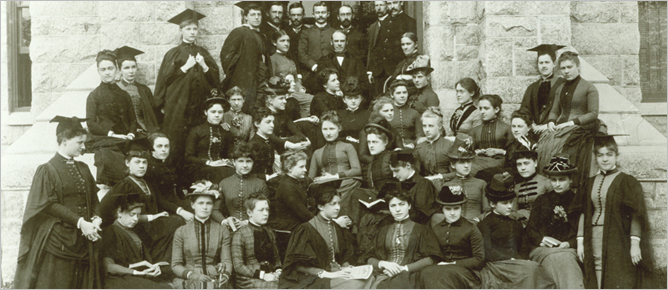
Towards the end of the fabulous marathon known
as #WhDigWrld (Women’s history in the digital world) I had
a flash, this must have been what it was like at those first Berks (or other
women in _____ conferences) in the early 1970s.
Nancy
Rosoff actually invoked the Berks held at Bryn Mawr in 1976 (see Clio’s
Concsciousness Raised for some of the papers).
The conference had my head
spinning. First Laura
Mandell blew my mind by showing how she
counters hegemonic TEI, in which female sex is coded is 2, male as 1 (cf Simone
de Beauvoir). There then ensued some
discussion about the ramifications which I
realized later from reading the Twitter feed was actually arguing. That made me sad, but as a historian I also
knew it wouldn’t really be a feminist conference unless there was arguing. New field, new work, going to be new disagreements.
Networking occurred
everywhere. I met many tweeps in person,
had wonderful conversations on everything from the transition to going co-ed to
dinner with graduate students doing amazing digital work. Every person I spoke with had some fabulous
plan to teach, research, or publish in women’s history or literature using
digital means. Everything was sketchy,
provisional and so exciting I hardly knew what to focus on first.
I had a great lunch picking
the brains of Cameron Blevins and Bridget Baird and
debating topic modeling methodology. I
saw Margo Hobbs’ taxonomies evolving in her
Omeka presentation and realized (once again) that doing digital work is
changing not only our tools but our thinking.
Anna St. Onge bravely presented her
“failure” that was SO not because I learned a great deal from her
presentation. I met Alla Myzelev and made a great connection
for my next conference paper on yarn-bombing.
Challenges of jobs, tenure,
and funding, legitimacy of the work in other words, also came up. For some women who had attended those 1970s
conferences that conversation was depressing.
Mary Kelley wanted to know what was happening to all the canon
revisioning scholars did in the 80s and 90s as the “big” male authors get more
funding for digital projects. I was
reminded that a similar thing occurs in history. The need to #transformDH still
exists. We exhorted one another to push
harder, work sneakier (I saw a fabulous project presented by Jen Palmentiero, from the HVRH.org based on a “failed” grant
applications that became the basis of an online exhibit), and support one
another. Jen Serventi reminded us to
make use of the funding agency offers to review grant applications prior to
submission.
By the end of the day, we got
down to the nitty gritty, what should we be teaching as the digital history
toolkit? In an ever-evolving field with
so many trajectories we realized it was NOT what we learned but HOW we learn. The need to keep connected seemed even more
important than ever. I was excited to
hear Jennifer Redmond announce that there would be another conference next
year.
Resources
Conference repository
(not up yet)
#WhDigWrld plenary storified
#WHDigWrld
tweet archive in storify
my presentation http://bit.ly/Ym1kjg notes http://bit.ly/YyWTMe video http://bit.ly/WXnHcV from#WhDigWrld
my presentation http://bit.ly/Ym1kjg notes http://bit.ly/YyWTMe video http://bit.ly/WXnHcV from
Thanks for the great report from this conference. I wanted to attend, but had a conflict (and now cannot remember what that was!). Enjoyed this update though!
ReplyDeleteJulie